
Exclusive: Guitarist Earl Slick Reveals New David Bowie Album Details
Earl Slick needs no introduction. A killer rhythm guitarist and long-time David Bowie collaborator, the 60-year-old played on John Lennon’s ‘Double Fantasy,’ has recorded with Ian Hunter and played in the post-Stray Cats group Phantom, Rocker & Slick.
In recent years, the Staten Island native toured with the New York Dolls (including the summer 2011 tour with Motley Crue) and started designing a line of hand-painted guitar straps called Slick Straps. He also regularly visits School Of Rock outposts all over the U.S., jamming and speaking with the students.
Slick is already having quite a busy 2013: He has plans to make a record with Austin guitarist Rosie Flores, and he’s in the works of setting up some of his own tour dates sometime before the end of the year—“depending on what happens with the other guy that just put a record out [Tuesday] for the first time in 10 years,” he laughs dryly.
That “other guy,” of course, is Bowie, who released a new single, ‘Where Are We Now?’ and announced a new album, ‘The Next Day,' on his birthday, Jan. 8. Slick has played with Bowie off and on for better part of the last 40 years, both on tour (including Bowie’s last round of concerts, in the early ’00s) and on classic albums such as ‘Young Americans’ and ‘Station To Station.’ During a 45-minute interview, Slick was clearly happy to finally be talking about the new Bowie album -- for which he recorded parts in summer 2012.
“I’ve had a gag on since last May,” he says. “David got in touch with me out of the blue, and he said, ‘I’m ready to go back in. What are you doing? Are you around? Are you touring?’ I said, ‘No, just get me some dates.’ We started banging dates around -- and he was already recording -- and I went in and did all my stuff in July. But do you have any idea how many interviews I’ve done since May, with this under my belt, which I couldn’t say anything about? It was horrible!” Slick laughs.
‘The Next Day’ also features contributions from an impressive lineup of musicians in addition to Slick, including familiar Bowie collaborators such as drummers Sterling Campbell and Zachary Alford, guitarists Gerry Leonard and David Torn, and bassist Gail Ann Dorsey. Tony Visconti, who also produced ‘The Next Day,’ contributes bass, as does Tony Levin, who’s known for his work with Peter Gabriel.
Slick gave UCR some insights into ‘The Next Day,’ talking about his contributions and how the rest of the album shaped up.
Were you surprised when Bowie called you to do some recording?
Nothing he ever does surprises me. It doesn’t surprise me when he shows up; it doesn’t surprise me when he disappears. It’s just DB.
I was really impressed by the secrecy. That’s almost unheard of, for no news to leak about something like this.
Oh, I know. And especially because I had the cover for the Christmas issue of 'Guitar Player' magazine. That was the hardest one -- it’s a double issue and it stays on the stands longer, and they did a 14-page spread on me, and I’m thinking, “Christ, and I can’t even say anything.” Anyway, he appreciated that -- and I got a nice thank you for keeping my big mouth shut.
Was the secrecy built in from the start?
Oh yeah, right from the beginning. Because he didn’t know when it was going to be done.
You did all your parts last summer. How much of the record was done when you came in?
It was weird; I’m not really sure, because he had been cutting tracks. And then I went in and I cut three from scratch with me and David and Sterling Campbell on drums, and Tony Visconti playing bass. And then he had other tracks that were already done, that were missing some guitars he needed from me, and I did those.
Do you even know what the entire album sounds like? Have you heard the entire record?
Yes, I have. I don’t want to give too much away, but it’s really, really, really good. And it’s a bit eclectic, so it’s not all like what you heard.
Tony Visconti did an interview with the BBC earlier this week, and he said that the single is very different in tone from the rest of the record.
It is. Okay, so he’s let the cat out of the bag a little bit, then -- good. It’s rocking. There’s a lot of rockers on there, I can tell you that.
That’s what he said: “It’s quite a rock album, the rest of the songs.”
Yeah, it is. I mean, there’s a few kind of really cool mid-tempo ones in there as well, but I’m the go-to guy for the rock stuff with David. And that’s why I’m always there.
What was your methodology when you were adding your music? How did you motivate the performance you wanted to get? How much direction did you get?
You know, we’ve been doing this since day one, and what we’ll do is, we’ll sit down and we’ll listen to the stuff. And he’ll ask me how it hits me -- how does this hit you, how does that hit you? Or he’ll go, “This one you gotta be on.” And we’ll sit down, we’ll listen to the song -- well, we’ll sit in the control room with a couple of acoustic guitars and then we just bang ideas around. I’ll go, “What do you think about this?” He goes, “What do you think about that?” It’s not like taking direction as a session player would take direction, because that’s why I don’t do sessions—cause I can’t take direction. [Laughs.]
What he’s done since day one -- and still continues to do -- is, he knows exactly what it is that I bring to the table, and that’s what he wants. He doesn’t want me to sound like anybody but me. So we just sit there and we just hash through ideas until something hits one of us, and then we record it. It’s real casual -- you know, you throw a couple cups of coffee on the table and you pick up a few guitars and we listen through some tracks. And he already knows pretty much what he wants me on, but then I’ll say, “Well, let me play you these and see if these hit you. If they do, let’s work out some parts.” It’s really casual. And that’s why it gets done quickly and efficiently, because it’s all done organically.
The music I really like tends to be the more spontaneous music -- not very meticulous. There’s a time and a place for that, but it can sound so airless and stuffy.
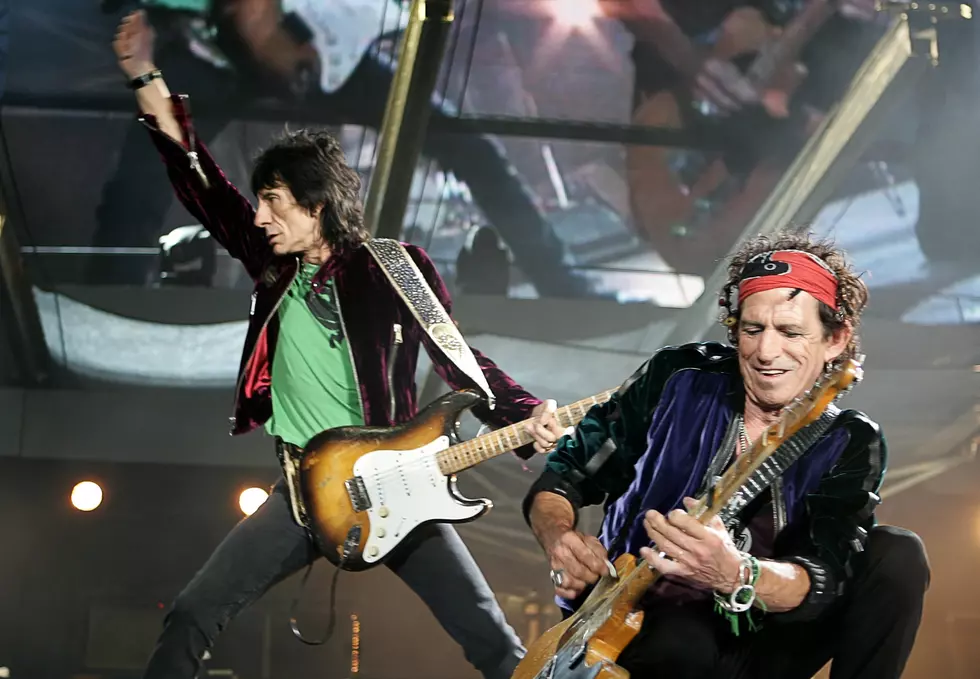
It’s really funny, as sophisticated as some of his records sound, he’s not anal about this stuff. And neither am I, and that’s why we get along so well. I’ll do a take that’s really not perfect, but it is perfect, because it feels great. Therein lies the perfection: It lies in what it feels like and what it does to you emotionally, not the exact notes. I can play a note that’s a little bit on the outside -- like, "What the hell was that?" -- and then we listen back to it and we go, “Wow, that felt really good.” And we just leave it alone. Whereas some guys will sit there and they’ll try to fix a weird note. Those weird notes, to me, is what really makes it happen. Of course—listen to the Stones. Keith Richards is my hero. In my mind, he’s the best guitar player ever. And Keith’s stuff has definitely got some urgency to it, and it’s definitely not perfect. But boy, when it comes to feel, it doesn’t get any more perfect than Keith.
I think the term is “loose.”
It is -- it’s loose, and it’s emotional. That’s what it is. And that’s, to me, what rock and roll is supposed to be about. If you want perfection, go see a symphony orchestra.
How was the studio atmosphere? People might be surprised to hear that it might be relaxed.
That’s what it is. It’s just a really relaxed, casual, hanging out… I wouldn’t liken it any different than if we were just sitting in my living room, only there happened to be a recording machine in here. That’s what it feels like.
When you were collaborating, did you get any inkling as to why now finally it was time for Bowie to put out a new record?
You know, I don’t even bother asking. Obviously, it was time.
There are some things you don’t question.
No, you know, you really don’t. I don’t question much of anything like that; it’s not in my nature. I don’t need to know why -- I just need to be there, that’s all. [Laughs.]
When you guys were bouncing ideas off of each other, were there any specific influences you wanted to bring? Or any that stood out to you that ended up happening?
Well, I can tell you that there’s a couple of the rock songs…cause, you know, admittedly -- and it’s not any big mystery -- my rhythm guitar playing is very likened to Keith [Richards]. Because he’s the guy I’ve been listening to -- and still do every single day -- since I’ve been 12 years old. You’ll be getting some of that on some of the rock tracks from me. He would say, "Do that you-know-what." [Laughs.] You know somebody that long, and if he says "you-know-what," you completely get it. [Laughs.] And you know what, not only is it awesome—it’s priceless.
When you’re playing with someone for so long…
Almost 40 years!
How did this experience compare to some of the other times you guys have recorded in the past? Was there anything that stood out to you?
The only thing was is that this one had a lot more secrecy going on. [Laughs.] I mean, one day I went out to have a cigarette in front of the studio, and something felt weird. Cause I would hang out in the doorway, in a little alcove; I didn’t even walk into the street. And something felt weird, and I peered across the street, and there was a guy there with a camera on a tripod. So I put my cigarette out and went back inside. [Laughs.] Cause if they see me, they can put two and two together.
That’s kind of fun to think you’re making a record and nobody knows about it. It’s like you’re on a spy mission or something.
It was fun for a little while, but then when I started doing interviews -- and after I got all excited after I finished doing the tracks and I was bursting -- it wasn’t fun anymore.
Are there any thematic things that really stand out to you on the album? Everyone has said the lead single is very introspective and inward-looking and looking backward…
It’s not all like that. Some of them, the lyrics are as straight ahead as David can write a lyric -- cause he’s not known for writing straight-ahead lyrics. He hadn’t finished the lyrics when we were in there, either. The way he writes is, we’ll get a basic thing down, and he’ll have a basic melody going on, but it’s done so much organically and off-the-cuff, that he will go back later and finish the lyrics. You get an inkling when you’re in there, but you’re not quite sure what it’s going to be until later. There’s a bit of mystery that we even have, because I left the studio thinking…I mean, I played on it, and I’m going, “Boy, I’m curious to hear what this is going to sound like!” [Laughs.]
Is Bowie going to be touring? I think that’s what everyone wants to know.
We don’t know. Obviously, we want him to. But right now, that’s a big if. Like I said before, sometimes he shows up and sometimes he doesn’t. I could get a phone call tomorrow saying, “Hey, you know what? Here’s the setlist.” I don’t know. I can’t speak for him or the organization. Obviously, the band would love to go out. Even if it’s not a huge tour, we would like to go out and do some gigs. But that’s yet to be seen.

More From 96.1 The Eagle